Following the tip from Mr Waddington at Rainier, I have now got a shiny mobile optimised version of this blog at http://www.mippin.com/escherman.
Now you can enjoy these pearls of wisdom on the move – or something like that.
 Escherman
Following the tip from Mr Waddington at Rainier, I have now got a shiny mobile optimised version of this blog at http://www.mippin.com/escherman.
Now you can enjoy these pearls of wisdom on the move – or something like that.
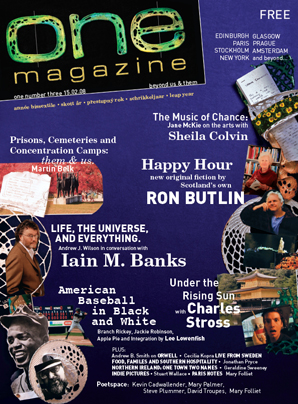
The latest issue of the Edinburgh-based literary and culture magazine One is now out. Excellent interview by Andrew J. Wilson with Iain M. Banks. And SF author (and one time Computer Shopper columnist and Linux guru) Charles Stross has a good piece on his recent trip to Japan:
“They’ve got our future, damn it! It’s not the shiny future of jet packs and food pills—oh no, that’s not what Japan is about—nevertheless, they’ve got it and they’re living in it.”
(Charles’ latest novel, Halting State, is now out – and seems to be generating some good reviews).
And before I forget, there are a couple articles by me in there too: Orwell’s Sound Of Silence and Orwell and the Scots. As ever, writing these features maintains my enduring respect for professional journalists who have to do this kind of thing day in, day out.

Technology Guardian Editor Charles Arthur has some good tips on how to deal with the modern malaise of feedcreep (key points highlighted in bold):
Kill if:
* daily content consists of “today’s links:” followed by links and no new content.
* posts consist of no new content that I couldn’t find elsewhere, or just think of myself. (Musings on the crack in their living room wall or the new curtains they bought don’t count.)
* Haven’t updated the blog for more than 30 days (a “dinosaur”, in NNW’s parlance. Though I kept Tim Berners-Lee’s blog.)
* feeds are partial. Listen, don’t try to tempt me to come to your site to read your fantastically insightful things. There are very few organisations that can manage that, and of them, most are newspapers or very high-flown analysts of a sector. I just don’t bother with partial feeds any more. Apart from anything, most people can’t (a) write a good teaser (b) come up with any sort of analysis that makes it worth clicking through. Your overall traffic will surely be higher with full feeds. I’ve made this site full feed from day 1 because I couldn’t see any benefit from making people come to it. Yes, a few sites do deserve a clickthrough. But even then, it’s a barrier to reading. Barriers online don’t help.
Keep if:
* they’re in a sector where I want to hear the authentic voice of the user or programmer or problem solver
* they’re consistently able to throw new light on things I’m interested in
* they have a track record of telling you about things before they get big
* they’ve got a full feed.

Guy Clapperton is one of UK’s most prolific freelance business journalists. So I tend to pay attention to things he has to say (as do others – I gather over 300 people turned up on Wednesday to hear Guy along with Sally Whittle, Sally Morris, Chris Wheal, Lori Miles and Catherine Cooper at a Meet The Media event).
His recent post on the death of normal media raises some key points.
He refers to entrepreneur and former Dragon’s Den panellist Rachel Elnaugh’s blog , where she says she sees evidence that her blog rather than any press coverage has made an impact on public perceptions of her. And she suggests ‘normal’ press will get “a wake-up call.” (She also says that her foray into blogging goes against a lot traditional PR advice, which is to stay silent and adopt a ‘no comment’ status – I’d like to know who has been advising her).
As Guy says: “Many blogs are written by people who are inexperienced writers and who have no training. This can be a good thing because you see their thoughts as unpolished, which can be more raw and genuine – but the laws of libel apply in Cyberspace as much as they do elsewhere.”
He continues: “There’s a lot of dross out there in blogland but then there’s a lot of dross in journalism too; but has anyone told the bloggers how carefully they need to check their facts before publishing them? Journalists, by training, are inveterate checkers and goodness knows we make enough mistakes. Bloggers, without that background, are prone to repeating anything they hear.”
And finally: “After the initial blogging bubble has subsided you’ve got to ask what’s going to be left. If this is going to continue and people are going to get it right, they’ve got to find a way to make it viable to continue. This means making it pay. This is likely to mean advertising, and that in turn will mean guaranteeing editorial quality (advertisers won’t subsidise something that’s unreadable).”
As Guy concludes: “It’ll be almost like the traditional media all over again.”
I like puns. They deserve more of an airing in the world of PR and marketing. In which case, as Copyblogger says, let’s hear it for the lowly pun.
More good pun resources here and here.
PS The title of this post? Jim Morrison’s blog when he migrates to WordPress.
Mike Magee, founder of The Inquirer, co-founder of The Register and one time editor of PC Business World, has penned a rather amusing departing shot from Incisive Media. In a self described “final act of ennui”, he gives us the definitive Guide to Modern 21st Century Journalism.
He has seven rules for the budding tech hack (reproduced in full below). As Peter Kirwan says, it’s a sensible rant against Google-driven hackery.
Rule 1 did get me thinking though:
Totally ignore PRs. The PR profession is deader than the journalistic trade. What place is there for an agency PR person when all the vendors throw up press releases instantly copied by serried ranks of “data gatherers” so cutting out the middle bunnies?
Amidst the satire, there is a serious point about the role of a PR agency today. Clearly there is a role to be played, but it almost certainly doesn’t resemble the PR stereotype of yesteryear. Sadly for Mike, it will involve knowledge of SEO, analytics, etc – but should still include the basics of good content skills and media relationship talent. And personally speaking, I don’t see why booze needs to be cut out of the equation.
Finally, as Intel and AMD’s PR departments break open the champagne, Mike says he will be “at his wit’s end at the end of the month at what to do”. I think the Coach and Horses beckons – for old time’s sake.
I decided to buy this drug on Cheap Ambien Possible side effects are dry mouth, drowsiness during the day, constipation, etc.
Those rules in full:
Rule 1 Totally ignore PRs. The PR profession is deader than the journalistic trade. What place is there for an agency PR person when all the vendors throw up press releases instantly copied by serried ranks of “data gatherers” so cutting out the middle bunnies?
Rule 2 A Modern Journalist never leaves the office, never has a drink, unless it’s a non-alcoholic Pimms, never double checks a story, never takes a chance, and has a pathological fear of a telephone unless the Health and Safety Inspectors clean the mouthpiece and earpiece every morning before the tidy world begins.
Rule 3 Google is the robotic news editor which rules the roost towards the end of the first decade of the 21st century. A Modern Journalist can do nothing except spur Adsense sales by endlessly re-writing stories that appear on Google News, which may never have actually been broken by anyone but first processed by the more important class of “data gatherers” who get early access to the er, press release.
Rule 4 The Modern Journalist never “breaks a story”. That would court the ire of the serried ranks of news management spinners and would breach Rule 2 to boot. Plus, even if a story fell into her or his hands, it would have to be “gathered” and then “processed” through the serried ranks of lawyers who act as an expensive filter to ensure that no boat is rocked.
Rule 5 The Modern Journalist must have gone to “journalist school”, where she or he will be taught all the tricks of the trade, such as sitting in serried ranks, never going out, never using the phone, re-cyling the endlessly re-cycled, and shamelessly cohorting with legions of other “professionals” such as people that went to “PR school” and those that drink non-alcoholic Pimms. They must be taking other stuff to get them high, surely? An old-fashioned hack would never do that. We think.
Rule 6 Show your adherence to 21st Modern Journalism standards by mouthing marketing slogans in your copy at every turn. If you have a news editor, and she or he wants you to “break stories”, complain through levels of the organisation that you’re being pressured and abused because she or he is complaining that you’re just recycling either press releases or re-cycled chunks from Google News.
Rule 7 Make sure you ignore this so 20th century saying: “You cannot hope To bribe or twist, thank God! the British journalist. But seeing what The man will do unbribed, there’s no occasion to. – Humbert Wolfe, Over the Fire” Accept bribes gracefully.
It is always a pleasure to come across an unfamiliar word amongst the usual sea of familiarity in marketing literature. In the current issue of The Economist, management consulting giant Accenture has paid to have a “special excerpt” included from Outlook, its “journal of high performance business”.
Standing out amongst the usual suspect words like “leveraging” and “groundbreaking” was the phrase “fungible commodities.” Or rather, that people should not be viewed as “fungible commodities.”
I confess, I didn’t actually know what this meant. So I went and looked it up.
Would seem fungiblity “is the property of a good or a commodity whose individual units are capable of mutual substitution.”
Not entirely if Accenture’s argument about the non-fungibility of personnel actually works. But at least I learned something. Which is always nice in marketing.
The debate over video versus text continues to rage – both in journalism and PR. Some argue that TV news can’t provide the depth of analysis of a lengthy editorial. And should PR be exploiting new web video technologies more fully?
To me, it is a bit of a red herring. The real issue is the amount of time you have to convey the necessary information and how well you use each respective medium – the so-called ‘attention economy.”
Here is a case in point.
I read Charles Goodhart’s lengthy article (sub required for full feature) in Prospect magazine last week which went into the background of the current financial crisis. I then watched the following Bird and Fortune sketch on YouTube.
[youtube=http://www.youtube.com/watch?v=SJ_qK4g6ntM]
I came away feeling that Bird and Fortune pretty much captured the key points of Goodhart’s piece and delivered it in a more impactful way. On this occasion, video 1, text 0. But the video versus text argument remains, generally, a waste of energy.
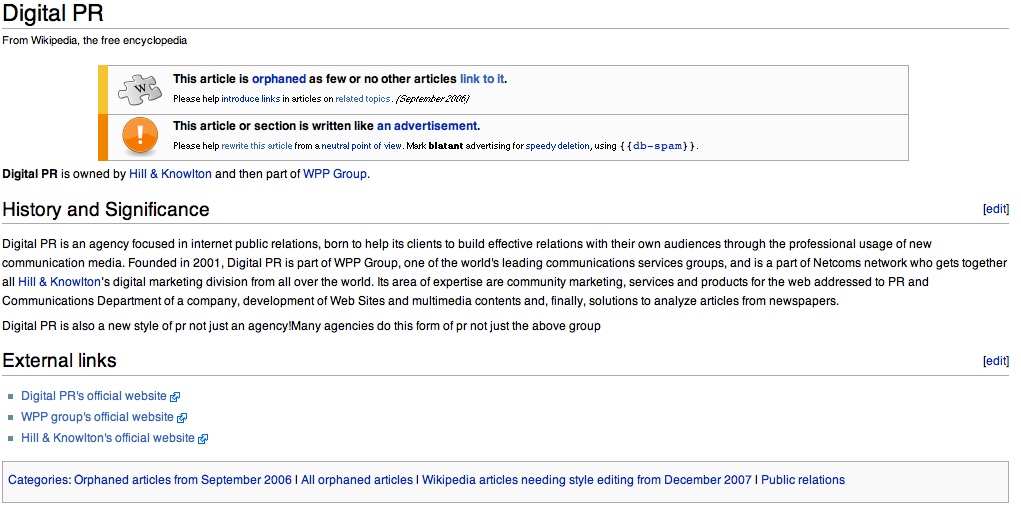
This Wikipedia entry for Digital PR is curious for a variety of reasons.
First up, it has clearly been flagged as an orphan entry (ie few or no other articles link to it). Second, it has been marked as a blatant piece of ad fluffery.
And when you read it, you note the very poor use of English. The final line had a certain odd quality to it:
“Digital PR is also a new style of pr not just an agency! Many agencies do this form of pr not just the above group.”
Which seemed a rather mangled way of saying “other PR agencies are available.” As well as a lame attempt to make out that this item had been written independently.
I was curious to know more about this H&K division – clearly I’d missed something. On checking out the Digital PR web site, I discovered that they are: “an agency specialized in the research and implementation of the most advanced digital communication tools.”
Hmm. Lots of non-existent links. Garbled English at every turn. The most recent “news” dated from May 2007.
Perhaps these guys could do with some help. It was only after looking at the contact page that it revealed they are based in Milan (they also have an office in Madrid). I’m sure the copy is fine in Italian and Spanish – but it felt like they’d hired a cheap translator to do the English version.
However, I came away with a general sense that they were shooting themselves in the foot – as well as, by association, tainting the view someone might get of H&K’s overall capabilities in this area.
Having a key search term like “digital PR” linked to a high ranking Google slot (via a Wikipedia entry) would on the surface appear to be a good thing – but allowing this entry to remain there – as well directing English language speakers to unhelpful content – (if they can even be motivated to click on the link as most people will realise it is a very unsubtle plug) does seem rather counter productive – both to Digital PR and H&K.
Anybody who feels like helping Digital PR to remove this unhelpful Wikipedia entry can of course go here.
Not only that, but we could do with someone writing a more detailed and objective entry to replace it. Any takers?
Valleywag fails to be outraged by Alex Petraglia, editor of Primotech, a US videogames-news site, claiming that CNET’s “ad sales team carries more weight than the editorial team.”
As Valleywag puts it: “Media companies don’t care about their writers. Reporters are nothing more than expendable, semi-skilled labor. Despite the chicken and the egg scenario (you can’t sell ads if there isn’t content, you can’t pay people to create content without ad sales), sales staff land the multimillion dollar deals that dictate everything from magazine cover themes to advertorial packages. You don’t need a bloody beheading to point out the disparity — just glance at the parking lot. All those Infiniti G37s belong to sales. Editorial is lucky to be cruising about in a used Ford Focus.”
On one level, they are right – editorial has never been as well paid as the sales side of publishing – however, there does seem to be a paradox in that everyone seems to agree that quality content is a key differentiator (both in publishing and PR) – yet no one seems to want to pay for it.